
Phonics
Share this page
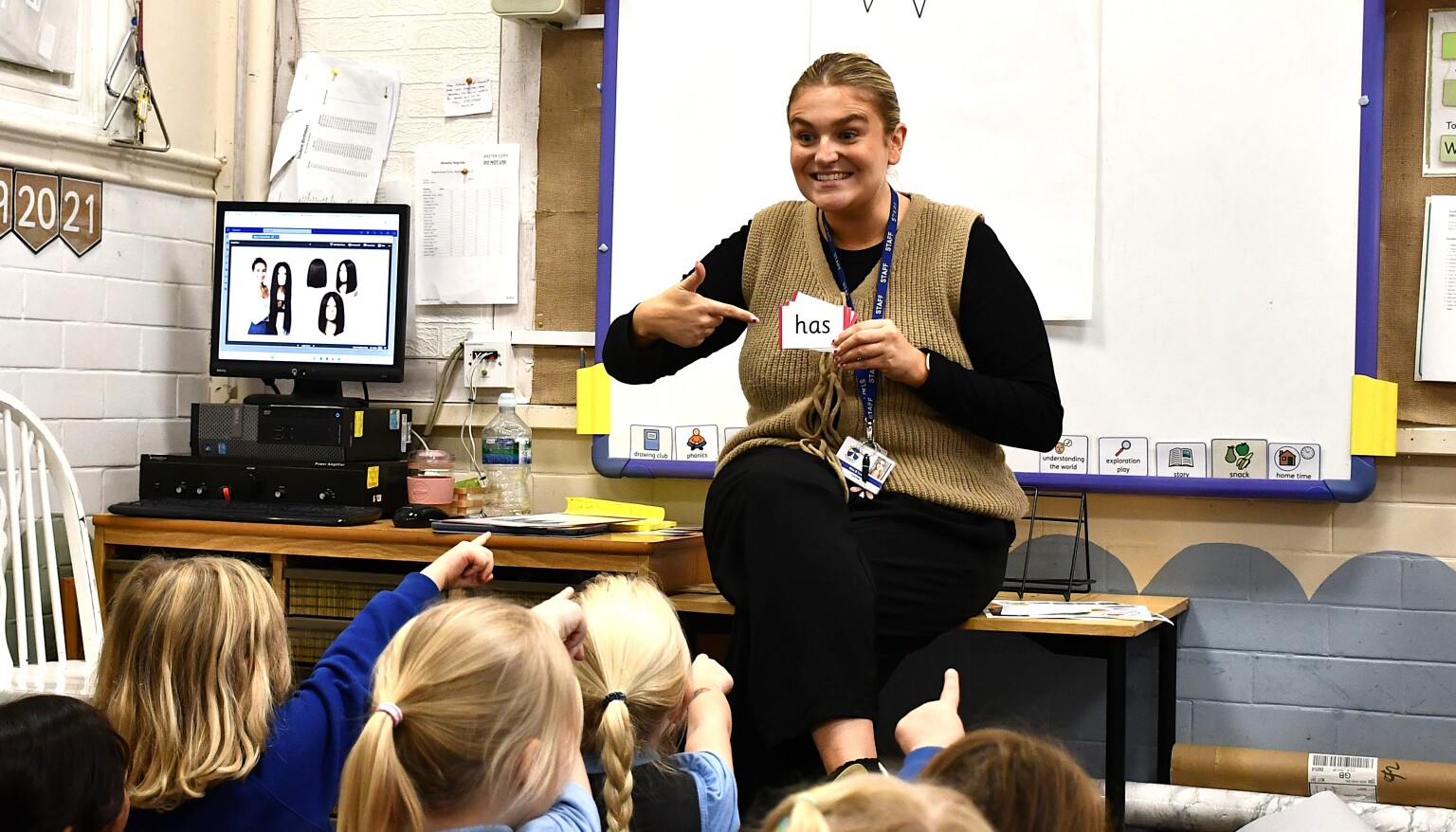
At Rockcliffe First School, we believe that learning to read is a fundamental life skill and the key to accessing the wider curriculum. We are committed to ensuring that all children become confident, fluent readers who develop a lifelong love of reading, during their time at Rockcliffe.
We teach reading through a systematic, synthetic phonics approach, following the
Little Wandle Letters and Sounds Revised phonics programme.
We follow Little Wandle Letters and Sounds Revised, a DfE-validated phonics programme that provides a consistent and structured approach to teaching early reading. Phonics teaches children the relationship between letters (graphemes) and the sounds they represent (phonemes). Children learn to recognise and say sounds accurately, blend sounds together to read words and segment to sounds to support reading and spelling. Children practise reading and writing ‘tricky’ and common exception words.
Our intent is that, by the end of a child’s Rockcliffe journey, all children will be confident, fluent readers and writers. We aim for children to have a deep and secure knowledge of Little Wandle Phases 2–5, enabling them to decode and spell independently, apply phonics skills in reading and writing, and approach unfamiliar words with confidence. Children will develop comprehension skills, a rich vocabulary, and a love of reading through stories, poems, and non-fiction. Through high-quality teaching and supportive interactions, they will also build resilience, curiosity, and enjoyment in reading, using these skills to communicate effectively and engage confidently with the world around them.
How do we teach Phonics?
The journey towards reading fluency begins in Nursery, where children develop the foundations for phonics through high-quality, play-based provision. During this stage, children are taught the foundational skills required that underpin later success in reading and writing.
In our Nursery provision at Rockcliffe First School, you will see:
Rhymes, songs and poems are an integral part of daily practice, enabling children to hear and recognise rhythm and rhyme and to become familiar with repeating rhyming patterns. High-quality stories are shared every day, providing opportunities for children to join in with repeated refrains (for example, “we’re going on a Bear Hunt!”) and explore rich language, including alliteration. This supports children in tuning into initial sounds in words, for example in phrases such as “slippery snake”.
Children are supported to develop focused listening and auditory discrimination through activities such as listening walks around school and “guess the sound” games. Children explore and compare sounds using instruments, copying simple rhythms and using body percussion, which helps to develop working memory and supports children in hearing patterns in spoken language.
Oral blending and segmenting through high-quality, adult–child interactions, is integral to our daily practice. For example, “Can you get your c-u-p… cup?” This early oral work is a key component of Little Wandle and directly prepares children for blending and segmenting with graphemes.
In line with Little Wandle guidance, phonics learning in the Early Years is embedded throughout the day, delivered through purposeful play, modelled consistently by adults and revisited frequently to support consolidation. By the end of Nursery, children will have developed secure Foundations for Phonics, enabling them to begin Phase 2 phonics confidently in Reception.
In Reception, you will see:
Daily, discrete phonics sessions. Lessons are fast-paced, interactive and engaging, with additional support provided where needed (see assessment support below). Each session is typically 20-30 minutes long and is a structured session:
- Revisit and Review – A quick revision of previously taught phonemes (sounds) and words.
- Teach – A new grapheme is introduced and how it sounds, for example ai. This often includes a mneumonic to help children remember the sound. E.g. ‘tail in the rain’.
- Segment and Blend – Teacher-led blending of words orally. E.g. r-ai-n = rain
- Apply in Reading and Writing – Children to practise writing and read words/sentences containing new sounds. Children to read and write ‘tricky’, or non-decodable words, such as ‘he’.
- Review and Assess – Teachers to observe children’s progress and idenify any children for Keep-Up support.
High quality resources are used, all of which are from the Little Wandle Scheme. Children have access to word mats, Phase 2+3 grapheme charts and tricky word mats, to scaffold learning.
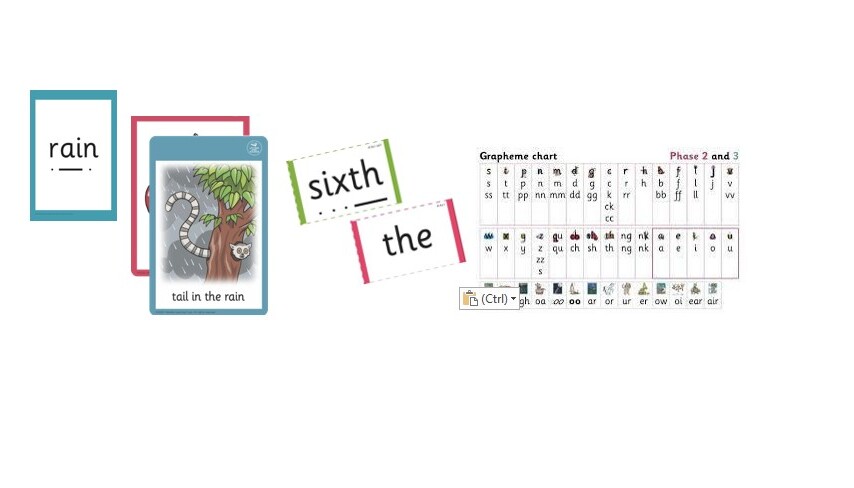
A progressive programme is followed, beginning with Phase 2. Children learn single letter sounds (for example, s, a, t, p, i, n), and read CVC (consonant-vowel-consonant) words, such as ‘map, tap, sat, pat,’.
Children then move on to Phase 3, where diagraphs and trigraphs are introduced.
Diagraphs – where two letters make one sound (for example, ch in ch-i-p).
Trigraphs – three letters that make one sound (for example, igh in m-igh-t).
In Year 1, you will se:
A structured Phase 5 phonics session, consistent with the approach used across all year groups. Lessons follow a similar structure to those in Reception. Children revisit previously taught sounds (GPCs) using flashcards, oral blending, and quick-fire reading of words.
In earlier phases (2–4), children have already learned many key sounds. In Phase 5, the ‘teach’ element introduces the idea that one sound can be spelled in different ways. For example, the ai sound can be written as ai (rain), ay (day), a-e (cake), eigh (eight), or ey (they). This is often referred to as ‘Growing the Code’ and resources used develop to include new sounds and graphemes.
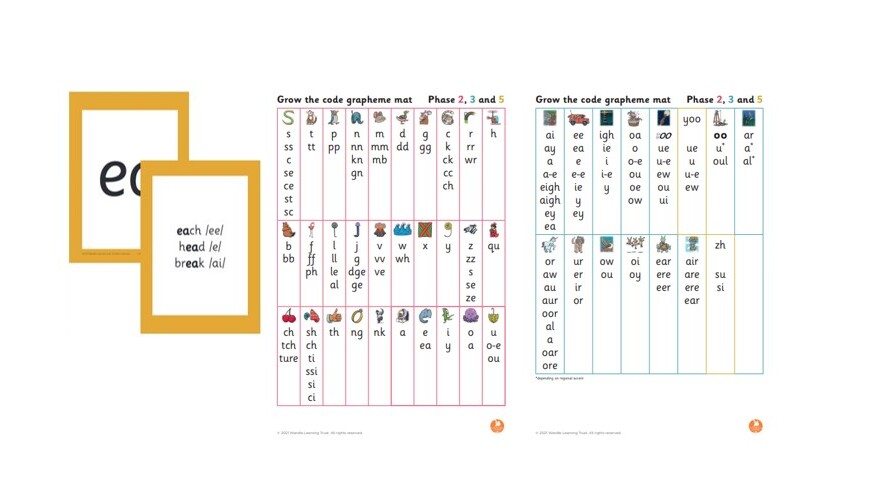
Sometimes, some words don’t fully follow phonics spelling rules and can’t be sounded out in the usual way. These are called Common Exception Words (CEWs), such as one, said and would. They are taught alongside our main phonics sounds.
In lessons, children are encouraged to use their phonics first, then identify and talk about any “tricky” parts of the word. For example, in the word said, children might sound it out as s–e–d, but the ai is the tricky part because it doesn’t make the expected ai sound. Children in Year 1 will practise reading and writing sentences, applying their phonics knowledge and recalling common exception words.
Phonics Screening Check
As with Reception pupils, children are assessed regularly; more details can be found in the assessment area of this document. At the end of Year 1, the children will be assessed through a national Phonics Screening Check. This takes place in school and can last between 10-20 minutes, in a friendly and relaxed environment, delivered by Rockcliffe teaching staff. Here, your child will read 40 words, some real and others pseudo, or “alien” made-up words. This check assesses whether your child has the necessary skills to decode and blend increasingly longer words. By the end of Year 1, our aim is that all children will have a secure understanding of Phase 5 phonemes, in order to meet the required expectations of the Phonics Screening Check. For more information, visit: Phonics screening check: information for parents.
In Year 2, you will see:
A growing emphasis on reading fluency, understanding and spelling, as children move from learning to read, towards becoming more independent readers and writers.
The programme begins with ‘Bridge to Spelling’. This is approximately a six-week transition period where children recap the sounds that they have already learned that support reading, and learn to apply them more confidently to their spelling and writing. This unit is designed to move children from writing phonetically plausible words using phonic sounds to rule-based and pattern-based spelling. Children move from hearing sounds to choosing spellings. They learn to identify all the ways to spell a sound (e.g. ai, ay, a_e, eigh) and select the most likely spelling depending on the word. For example, the ai in the words rain, main, and plain can be found in the middle of the word. Similarly, the ay sound is often found at the end of a word, such as in the word play. Here, children are learning to make thoughtful choices when spelling and build confidence when writing independently.
Following Bridge to Spelling, children will begin to learn more complex spelling patterns and apply basic spelling rules when writing sentences. For example, children will learn double consonant rules (e.g. run and running), or dropping the ‘e’, such as in the word ‘making’. Children will learn and apply common suffixes, such as -s, -es, -ed, -ing, -er, and -est, and learn word families (e.g. play, played, playing). Children will also continue to learn and practise Common Exception Words (CEW), such as would, could, should; you can find an overview of these words on our website.
In Key Stage 1 (Years 1 and 2), all children take part in weekly spelling practice. Each week, children are provided with a list of focus words via Seesaw to practise at home. Spelling practice is carried out in a supportive and constructive manner, with further opportunities to rehearse and apply the focus spellings in school.
By the end of Year 2, our aim is for all children to become independent readers and writers. Children will read fluently, spell and write with increasing accuracy and independence, and have a good understanding of a range of texts.
Opportunities for Reading
We provide regular opportunities for children to read throughout the day, with reading embedded across all lessons and daily routines. Children read with a range of adults during the week, including class teachers, Learning Support Assistants, trainee teachers, and school volunteers.
Children from Reception to Year 2 will participate in Guided Reading sessions. Here, children work in a small group with an adult to practise reading a book that is carefully matched to their ability. Book levels are determined based on children’s half-termly assessments (see the assessment section of this document). In a guided reading session, you will see a small group of Rockcliffe children reading together with an adult, using a book that is carefully matched to their reading level. We encourage re-reading to build fluency and confidence and aim to read the same book, three times in one week.
Each session has a different focus:
1. Decoding – using phonics to read unfamiliar words.
2. Prosody – reading with expression to bring the text to life!
3. Comprehension – understanding what has been read and what is being shown in the pictures and being able to talk about it.
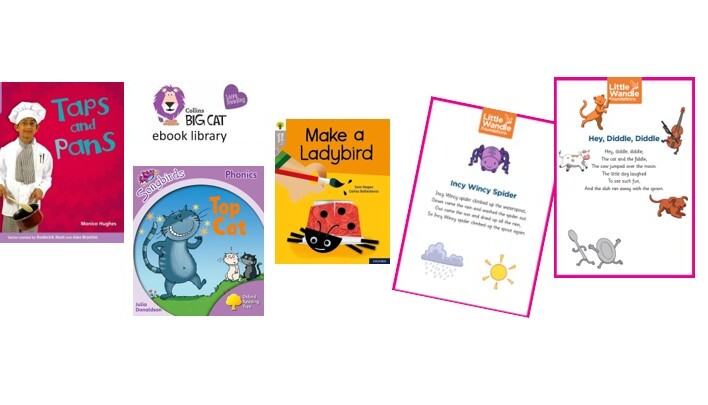
Rockcliffe pupils will also have a Home-School reading book. Further information about this can be found in our Guide to Home-School Reading, which can be found on our school website. In addition to this, pupils have access to Collins Big Cat E-Books and will be provided with a username and password to access a wider range of phonically decodable texts, matched to their reading level. Alongside phonics, children enjoy daily story time using high-quality texts and opportunities to explore a wide range of authors and genres across the Rockcliffe curriculum.
Supporting your child when Reading at Home
Here are our Rockcliffe ‘top tips’ for supporting your child when reading at home, from the staff team!
• “It’s okay to read the same book, over and over again! Re-reading a text is beneficial in more ways than one; the first time the children read, it may take them a little while to decode and read the words. However, by the third time they’ve read the book, the children can really take in the story and begin to understand what is happening!” – Mrs Ratcliffe
• “Have you ever heard of the saying, ‘a picture is worth a thousand words?’ We can gather so much information about a text from the images in a book. A single picture can show or explain things clearly to children and even give us clues about what might happen next!” – Mrs Duggan
• “I think that it is really important to learn how to say the phonic sounds that your children learn, rather than just letter names (ABCs). Sounds such as ‘ai, ee and igh’ help the children learn to read by decoding, and often letter names don’t match how words sound. The Little Wandle website has clips which show you how to pronounce all of the sounds your children will learn!” – Miss Boyd